Vorwerk Group DE | Reports & Publications

Reports & Publications

Vorwerk Gruppe Rauental Pflanzen 01

Transparency and precision als a foundation of every responsible decison

Strengthen data-driven decision-making to prioritize sustainability initiatives, support continuous improvement, and transparently communicate progress in our Sustainability Report.

Vorwerk Gruppe Karriere Hero

What drives us

Responsibility requires transparency. We voluntarily collect our sustainability metrics in reference to EU standards and have the metrics (Key Performance Indicator KPIs) externally audited – because we want to understand the impact of our actions and actively shape it.

At the same time, this transparency is only possible through the joint effort of many teams across Vorwerk’s divisions and entities. We are proud of the broad collaboration behind this process and of the many colleagues who contribute their expertise and commitment.

The basis for CSRD Reporting 

The double materiality assessment (DMA) forms the basis of our sustainability report. It helps identify the sustainability matters that are most significant by considering both the impacts of our business activities on people and the environment and the financial risks and opportunities related to these matters. Based on this assessment, we identified E1 Climate Change, E5 Resource Use and Circular Economy, S1 Own Workforce, S2 Workers in the Value Chain, S4 Consumers and End-users, and G1 Business Conduct as significant topics. 

Together, these topics reflect the three dimensions of ESG – Environmental, Social and Governance and provide the structure for our sustainability reporting. The sustainability matters identified through our DMA are reflected in part in the Vorwerk Home 3C framework. At the same time, the assessment highlights additional priorities that go beyond the framework and help create a comprehensive view of the sustainability matters relevant to the whole Vorwerk Group. If you are interested in the details of our DMA, you can read it in the introduction chapter of our CSRD report.

E1
Climate Change

Climate change covers climate change mitigation, climate change adaptation and energy use. This topic is relevant across our operations and value chain and informs how we manage environmental impact over time. It is also reflected in parts of our 3C framework, climate, which helps translate climate-related priorities into action.

E5
Resource Use and Circular Economy

This topic addresses how resources and materials are used, managed and kept in circulation as long as possible. It is closely linked to product longevity, repairability and a more circular approach to materials and design. It helps us understand how resource use can be managed more consciously across the product lifecycle – one pillar of the 3C framework, circularity.

S1
Own Workforce

This topic covers the working conditions, development, health, safety as well as equal treatment and opportunities for our own workforce. It matters because committed and capable colleagues are essential to long-term success and responsible business practice. It also reflects the importance of creating a working environment in which people can contribute and grow. It is reflected in our community pillar in the 3C framework.

S2
Workers in the Value Chain

This topic addresses the working conditions and treatment of people who make a material contribution to the development, production and delivery of Vorwerk’s products and services along the value chain. This includes in particular more than 129,400 self-employed advisors at the end of 2025 in direct sales as well as workers at suppliers in the upstream supply chain. It is reflected in the community pillar of our Home 3C framework.

S4
Consumers and End-users

This topic relates to consumers and end-users and includes product safety, comprehensible information, reliable services, responsible data handling and communication that supports informed decisions. It is particularly relevant because our products, services and digital offers are often part of consumers’ and end-users’ everyday lives for many years. Our customers, thus, our community is at the heart of everything we do – an essential part of the 3C framework.

G1
Business Conduct

This topic covers integrity, compliance, clear responsibilities and transparent decision-making. For us, responsible business conduct reflects our understanding of accountability as a family business and shapes how we take responsibility for people, products and processes. It provides orientation, strengthens reliability and supports the early identification of risks and consistent learning from tip-offs, thereby helping to build trust internally and externally.

Numbers that move us

Vorwerk Gruppe Circularity TM7

Deep Dive Circularity

We used 5,822 tonnes of secondary material in our products – equivalent to the cargo of around 243 fully loaded trucks.*


*Assumption: average payload of 24 tonnes per truck

Vorwerk Gruppe Sustainability Community

Deep Dive Community

For our sustainability report, we collected data from 24 countries in which the Vorwerk Group operates. This includes all countries with significant business activity – beyond these, Vorwerk is also active in a number of smaller markets.

Vorwerk Gruppe Rauental Solar

Deep Dive Climate

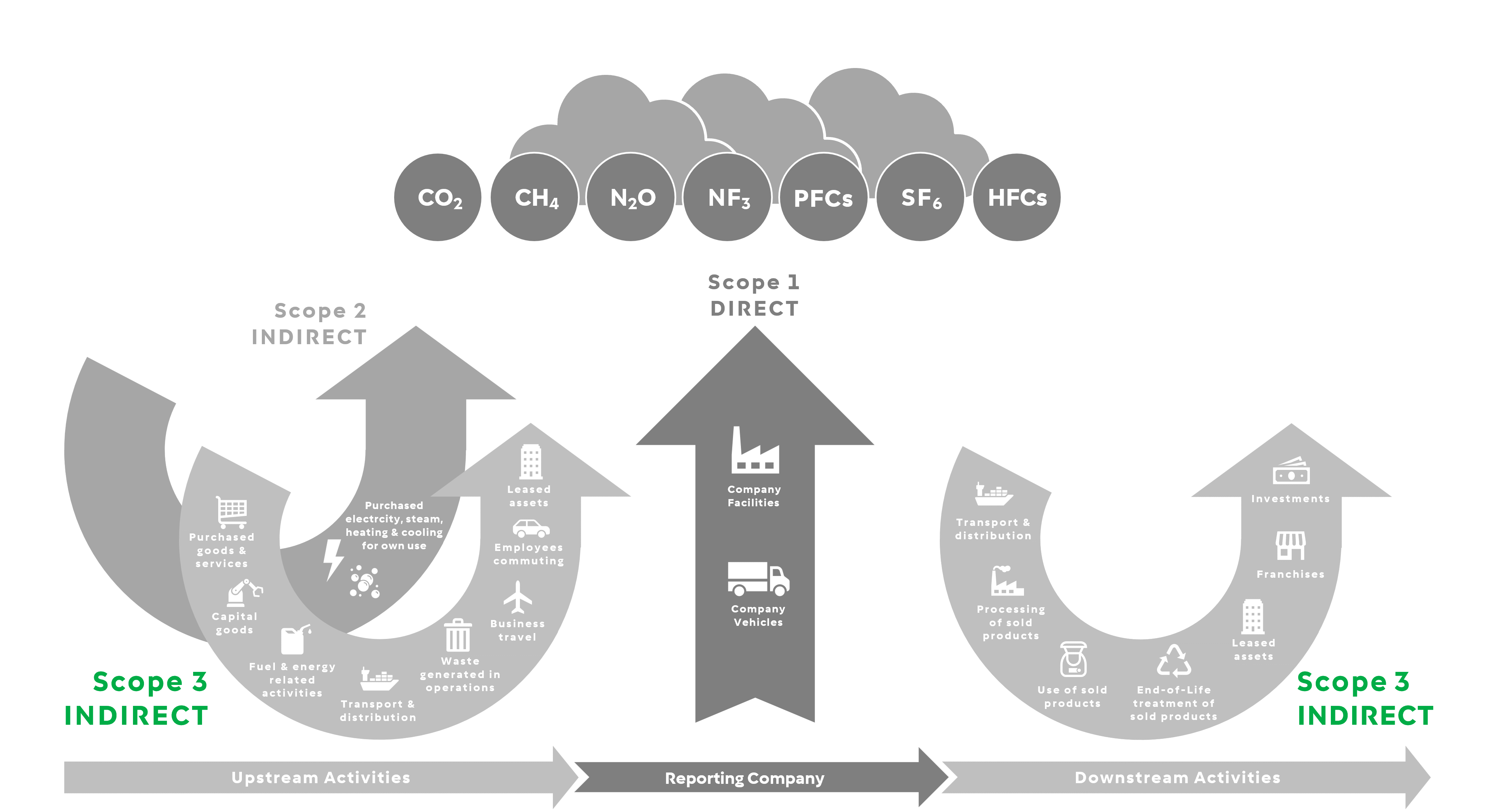
Greenhouse gas emissions Scope 1, 2 & 3 explained: The Greenhouse Gas Protocol is the global standard for measuring greenhouse gas emissions and a key basis for disclosure under ESRS E1. By classifying emissions into Scope 1, Scope 2 and Scope 3, it enables companies to build a complete emissions baseline.

20260717 GHG Protocol Model v01
Direct Emissions (Scope 1)

Scope 1 comprises a company’s direct greenhouse gas emissions from sources that are owned or controlled by the company. This includes emissions arising directly from its own operations. At Vorwerk, these emissions primarily relate to building operations, particularly heating, from processes of the three production sites, and the company-owned vehicle fleet.

Indirect Emissions (Scope 2)

Scope 2 comprises indirect greenhouse gas emissions associated with the generation of purchased energy, particularly electricity, district heating and cooling, that is consumed by the company. While these emissions do not arise directly from the company’s own operations, they result from its energy demand. At Vorwerk, Scope 2 emissions mainly relate to purchased electricity.

Greenhouse gas emissions of the Vorwerk Group in 2025 [t CO2e]

Scope 1: 8.905

Scope 2: 4.602

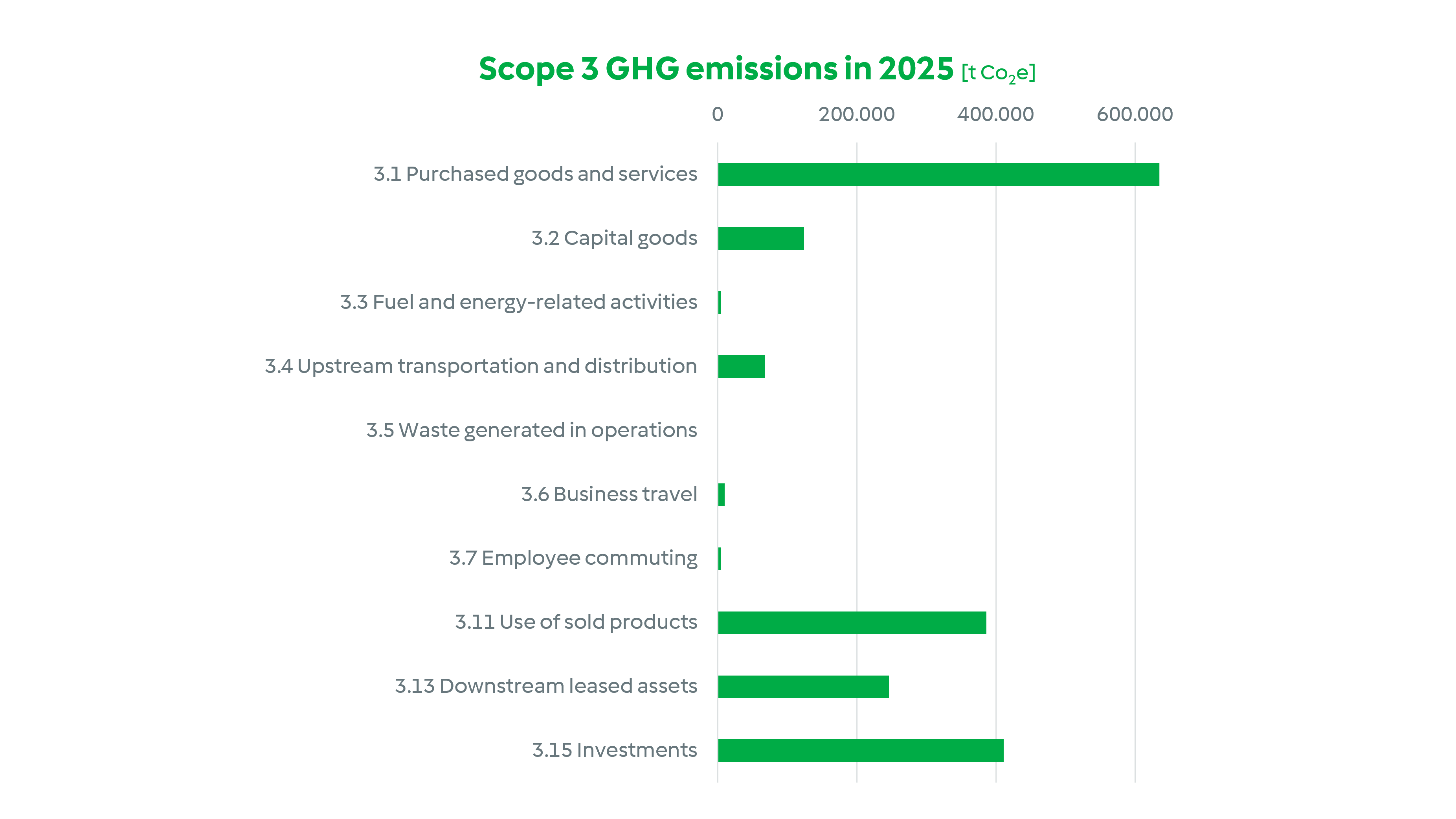
Scope 3: 1.891.124

Sum 1 & 2: 13.507

Other indirect emissions (Scope 3) 

Scope 3 comprises all other indirect greenhouse gas emissions that occur across a company’s upstream and downstream value chain. It includes emissions that do not fall under Scope 1 or Scope 2, but are linked to the company’s business activities — from raw material extraction and purchased goods and services to the use and end-of-life treatment of sold products. As Scope 3 typically represents the largest share of a company’s overall emissions profile, its assessment is essential to gaining a complete understanding of corporate climate impact. At Vorwerk, Scope 3 emissions primarily relate to purchased goods and services, the use of sold products, and the leasing and credit portfolio of the akf-Group.

E1 2 ENG NEW
Astrid Bayer

For us, sustainability is far more than a requirement: it is a driver of performance and a valuable foundation for effective business management. By making progress measurable and transparent, we create the basis to use ESG as a driver of long-term value creation.

Astrid Bayer
Director Sustainability/ESG/CSRD
Why does Vorwerk use reporting standards ?

Reporting standards generally ensure comparability, high data quality, and the necessary level of granularity across companies and over time. Although Vorwerk will only become subject to mandatory CSRD reporting from 2027 onwards, we are already reporting voluntarily in line with CSRD requirements, driven by conviction and in support of our Strategy 2030 (S30). This proactive approach enhances transparency, audit readiness, and stakeholder trust.

Corporate Sustainability Reporting Directive (CSRD)

The CSRD is the new EU directive for corporate sustainability reporting. It replaces the previous Non-Financial Reporting Directive (NFRD) and introduces significantly higher requirements regarding the content, structure, and traceability of reports. A key principle is double materiality: companies must explain, on the one hand, how sustainability topics affect their business and, on the other hand, what impact their business activities have on the environment and society. As a result, sustainability reports become more comprehensive, transparent, and comparable.

European Sustainability Reporting Standard (ESRS)

The ESRS translate the CSRD into concrete reporting requirements. They specify exactly what companies must disclose, on which sustainability topics, and in what form – from greenhouse gas emissions and labour-related matters to governance structures. For readers of sustainability reports, this creates a far greater degree of transparency, consistency, and comparability across European companies.

Science Based Targets Initiative (SBTi) 

The SBTi provides companies with a science-based framework for setting climate targets. At its core is the question of how emission reductions can be shaped in a way that is aligned with the 1.5°C goal of the Paris Agreement. For companies, aligning with this science-based pathway is valuable because it helps define climate targets that are credible, robust, and consistent with the remaining global carbon budget. Vorwerk aligns its climate approach with SBTi principles, while formal validation is currently not planned.

United Nations Global Compact (UN GC)

The UN Global Compact is the world’s largest corporate initiative for sustainable and responsible business conduct. It is based on ten universal principles related to human rights, labour standards, the environment, and anti-corruption. Companies that join the UN Global Compact commit to embedding these principles in their strategy and business processes and to reporting regularly on their progress. At the same time, the initiative supports alignment with the UN Sustainable Development Goals and provides an internationally recognized framework for responsible action.

Screenshot 2026 07 03 115206
Sustainability Reporting

Accountability requires transparency. That is why we track our progress on sustainability in line with EU standards, so that we can better understand our impact and take targeted action.

For more transparency on how we measure progress and what targets we are pursuing, please read our latest sustainability report.

What guides us

Policies and guiding documents provide the foundation for responsible conduct, transparency and consistent sustainability management across the Vorwerk Group. 

Documents to download
  • Code of Conduct for Business Partner en (PDF) Download
  • Vorwerk Policy Statement (PDF) Download
Certificates
  • Certificate Environmental Management System ISO 14001 EN (PDF) Download
  • Certificate Energy Management System ISO 50001 EN (PDF) Download
  • Vorwerk Kobold VK7 TÜV Certificate (PDF) Download